

Home / Information /
What is a dental implant?
What is a dental implant?
A dental implant is an artificial tooth root that is placed in the jawbone. It is usually a screw made of titanium, or less commonly a screw made of zirconium oxide, which is inserted into the jaw in place of a missing natural tooth root. A dental restoration can later be attached to this implant—typically a crown, bridge or denture. The implant therefore serves as a stable support, similar to a natural root, and enables fixed replacement of lost teeth.
After placement in the jaw, the bone around the implant usually heals within a few months. During this healing period, so-called osseointegration takes place: the surrounding bone tissue grows onto the implant surface and bonds firmly to it. Under ideal conditions, the implant can occasionally be loaded with a temporary restoration during the healing process. More often, however, the definitive restoration (such as a ceramic crown) is permanently attached to the implant once healing is complete.
What are dental implants used for?
Essentially, implants replace missing teeth in the most natural way. Single gaps can be closed with an implant and a crown without having to grind down adjacent teeth, as is necessary with bridges. If several teeth are missing, two or more implants can serve as abutments for bridges. Even in a completely toothless jaw, implants can be placed (usually four to eight per jaw) to anchor a full denture. Implants therefore often offer the advantage of enabling a fixed restoration that feels very close to natural teeth, while also helping to prevent bone loss that would otherwise occur without a tooth root.
Structure of a dental implant
A dental implant typically consists of three main components:
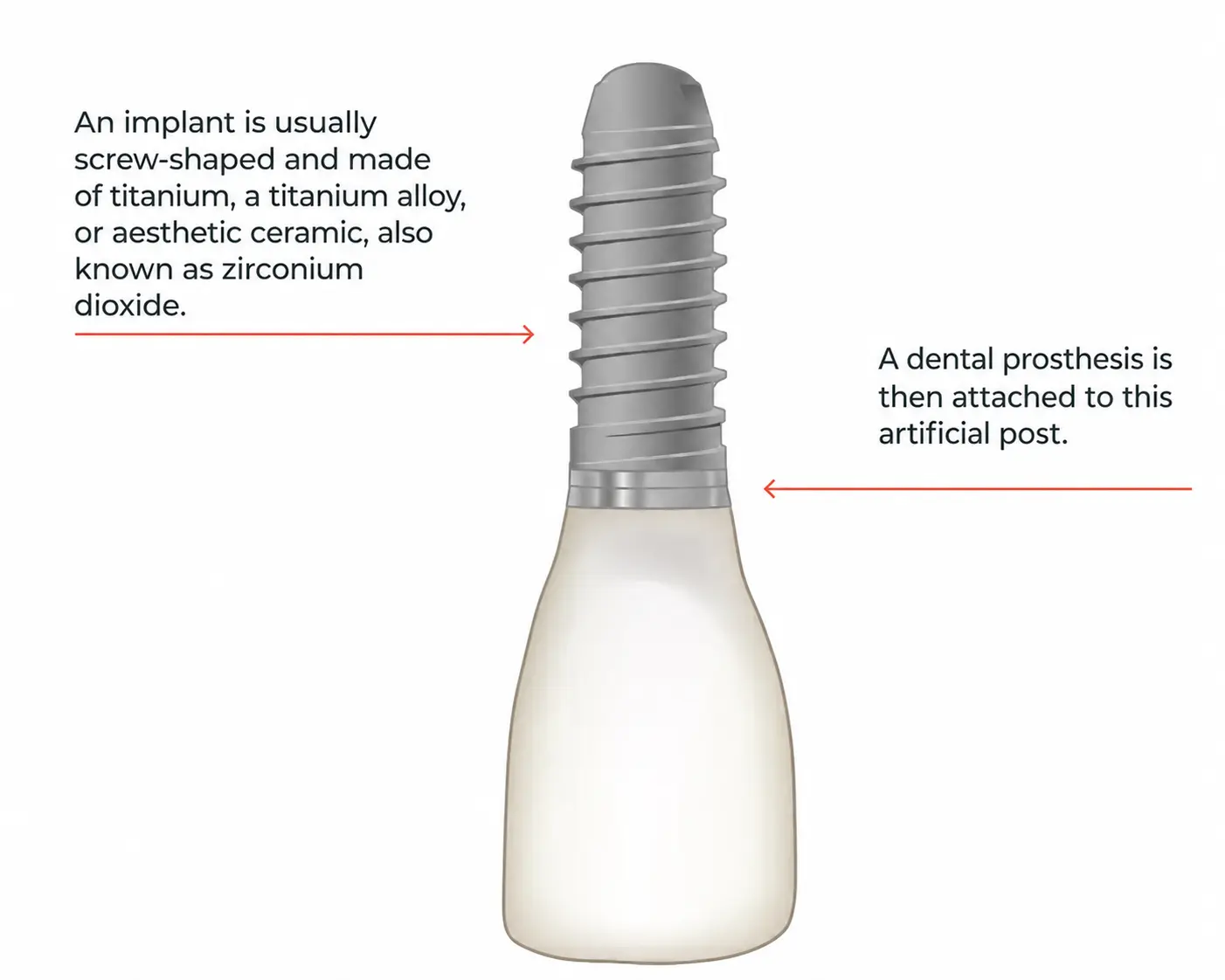
- Implant body: This is the actual screw or cylindrical body that is inserted into the jawbone. The implant body, usually made of metal (titanium), functions as the artificial root and fuses firmly with the bone.
- Implant abutment (abutment): The abutment is a small connector that is later placed on the implant body and protrudes through the gum. It serves as the interface between the implant and the restoration. Put simply, the abutment is the post that supports the crown and is attached to the implant.
- Dental crown or restoration: The crown is the visible part of the dental implant system. It is custom-made from tooth-coloured material (e.g. ceramic) and attached to the abutment. The implant crown looks like a natural tooth and takes over its function when chewing and smiling.
This division into implant body, abutment and crown is referred to as a two-part—or, strictly speaking, even a three-part—implant system. Two-part dental implants (implant body + separate abutment) are the standard today because they offer greater flexibility in prosthetic treatment. However, there are also one-piece implants in which the implant body and abutment form a single unit. In this case, a fixed post protrudes directly from the jaw, onto which the crown is placed. One-piece systems are used less often, but are used, for example, in ceramic implantology (many ceramic implants are manufactured as one piece for stability reasons) or for special mini-implants.
The implant
While a natural tooth, with its root, is anchored in the jawbone with slight mobility via the periodontal ligament, an implant is rigidly anchored through firm, direct contact with the bone (osseointegration).
Implant variants
A dental implant is a particularly high-quality and long-lasting option for replacing one or more missing teeth. It offers not only an aesthetically pleasing but also a functionally convincing alternative to conventional dentures. However, as simple as the term “implant” may sound, the actual treatment is anything but uniform. No two implants are the same, and not every solution suits every dental situation.
Depending on the number of missing teeth, the condition of the jawbone and the individual needs of the patient, different implant concepts may be suitable. That is why it is important to know the various treatment options and to understand which solution is appropriate in each case.
In principle, three implant variants can be distinguished, differing in structure, function and area of use: single-tooth replacement, replacement of a group of teeth, and implant-supported removable dentures. These three options cover a broad spectrum, from restoring a small gap to replacing all teeth in the upper or lower jaw. Which variant is ultimately used always depends on the individual dental situation and personal preferences.
Single-tooth replacement
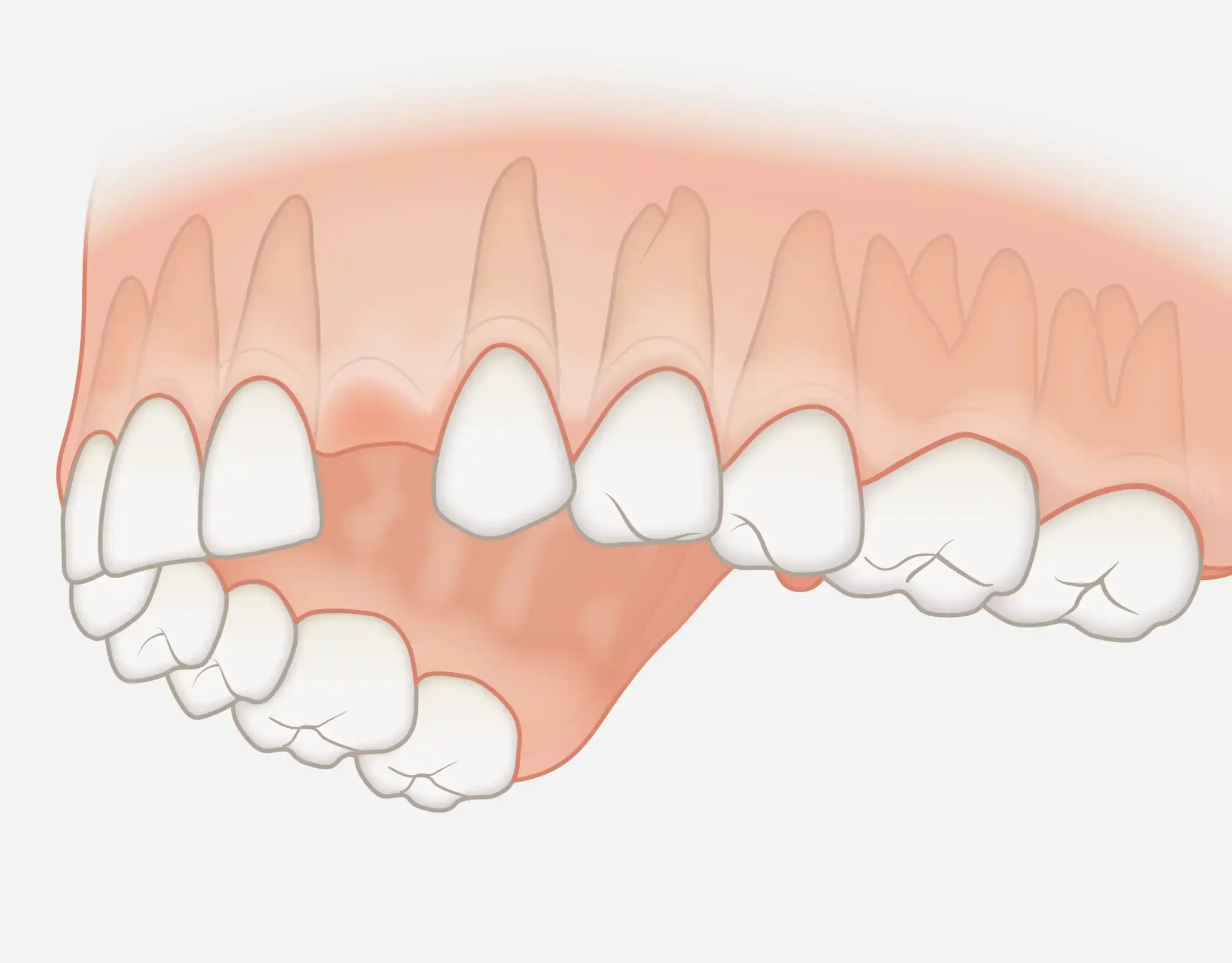
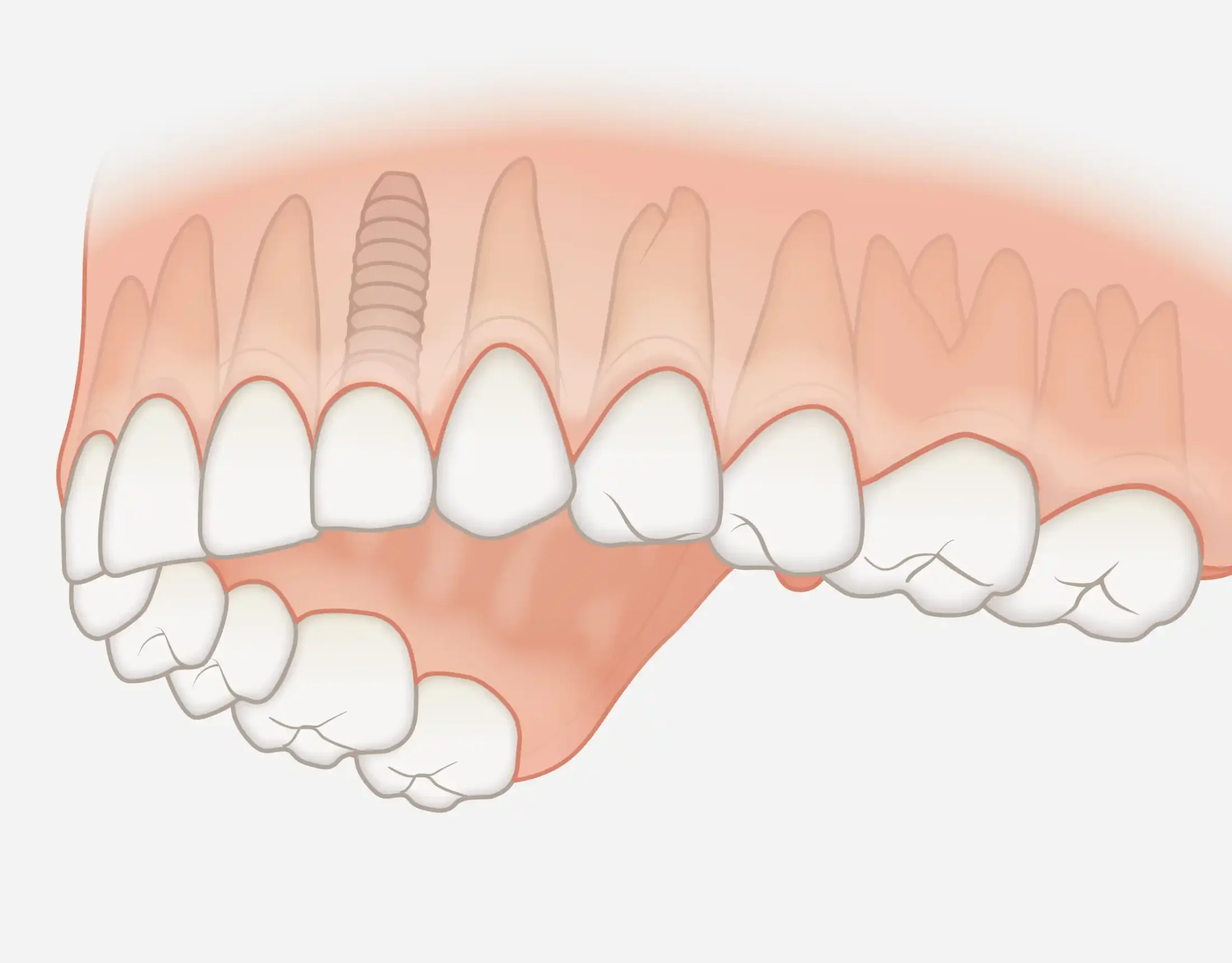
If a single tooth is missing—whether due to decay, an accident or advanced periodontitis—an implant for single-tooth restoration is now a particularly gentle and effective solution. In the past, a fixed bridge was often used to close the gap; today, implants are increasingly used as a modern replacement for the natural tooth root. The major advantage: with a bridge, the two adjacent teeth must be ground down and crowned, even if they are healthy. This results in the loss of valuable tooth structure.
A single-tooth implant avoids this problem entirely. A small screw made of titanium, or alternatively ceramic, is placed directly into the jawbone in the gap. This artificial tooth root fuses firmly with the surrounding bone within a few weeks. This natural healing process is called osseointegration and ensures that the implant remains permanently stable in the jaw.
Once the implant has healed, a custom-made crown is attached to it. It is precisely matched to the shape and colour of the surrounding teeth so that it blends harmoniously into the overall appearance of the dentition. The finished crown looks deceptively like a real tooth and fully takes over its function when chewing, speaking and smiling.
The tooth-preserving aspect of this method is particularly compelling: the neighbouring teeth remain intact because they do not have to serve as bridge abutments. The implant replaces the missing tooth in a natural way without affecting other teeth. This makes single-tooth replacement with an implant a durable, stable and aesthetically pleasing solution for anyone who values quality and long-term oral health.
Replacement of a group of teeth
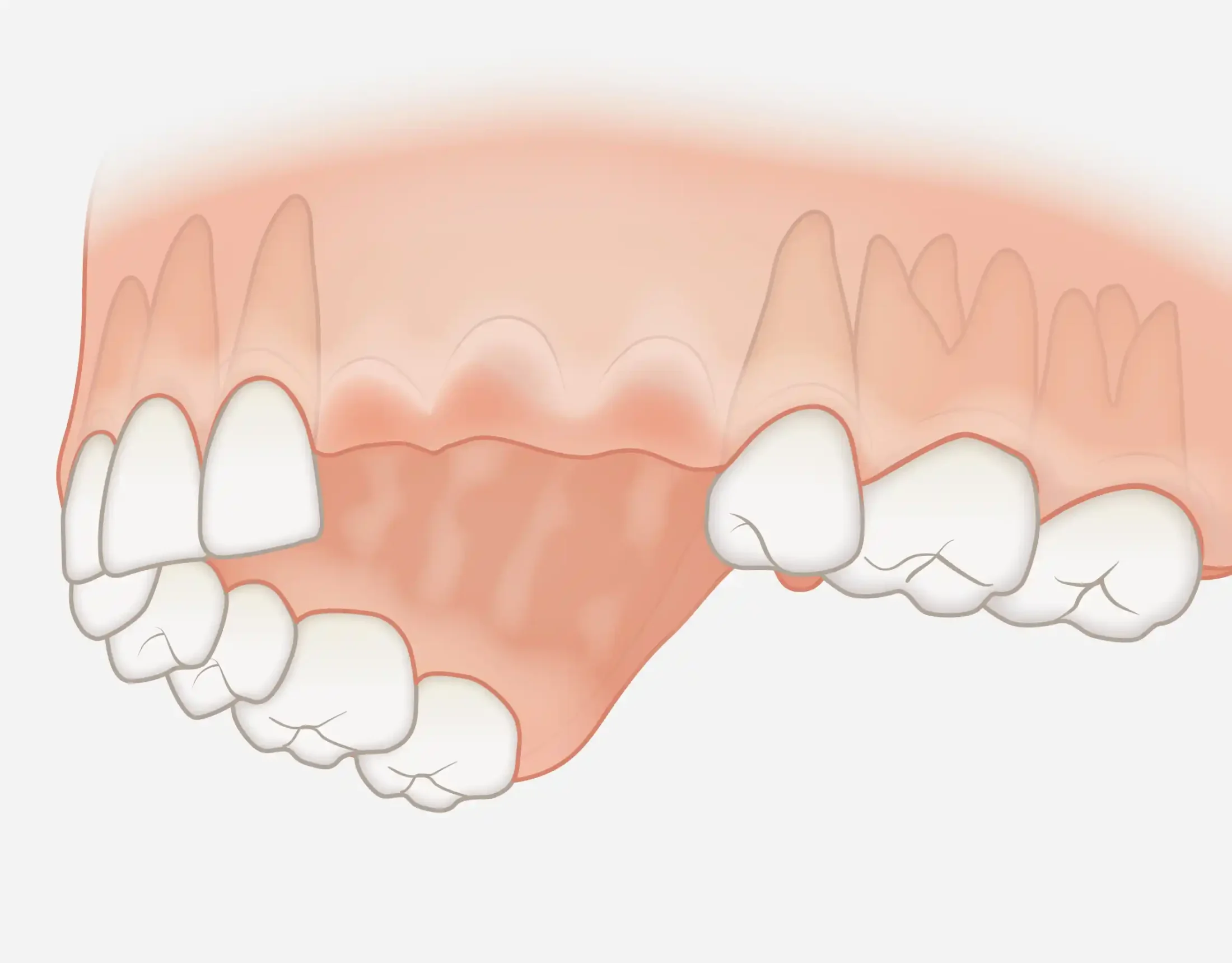
If several teeth are missing, for example due to an accident or a long-standing condition, a so-called group-tooth replacement may be the right solution. In this case, it is not necessary to replace each missing tooth individually with an implant.
As a rule, two or more implants are placed at the ends of the gap. A fixed bridge can then be attached to these artificial tooth roots, replacing the missing teeth in the middle both visually and functionally. This type of restoration is not only stable, but also distributes the forces generated during chewing evenly across the implants. The result is a resilient and comfortable restoration that feels very close to natural chewing.
A group-tooth replacement with implants is particularly useful when fewer implants are to be placed than the number of missing teeth. This makes the procedure overall gentler and often more cost-effective than placing individual implants for each missing tooth. Another advantage: healthy neighbouring teeth do not need to be ground down, as would be necessary with a conventional bridge solution. They remain fully intact and are not involved in the restoration.
Even with larger gaps, this method can provide a stable, aesthetically pleasing and functionally high-quality solution. At the same time, chewing loads continue to stimulate the jawbone via the implants. This helps prevent bone loss in the affected area and preserves the jaw’s natural structure in the long term.
How many implants are required in a specific case depends on various factors, including the available bone volume, the length of the gap and individual preferences regarding comfort and aesthetics. Careful planning by the dentist is the basis for a long-term successful restoration.
Removable dentures
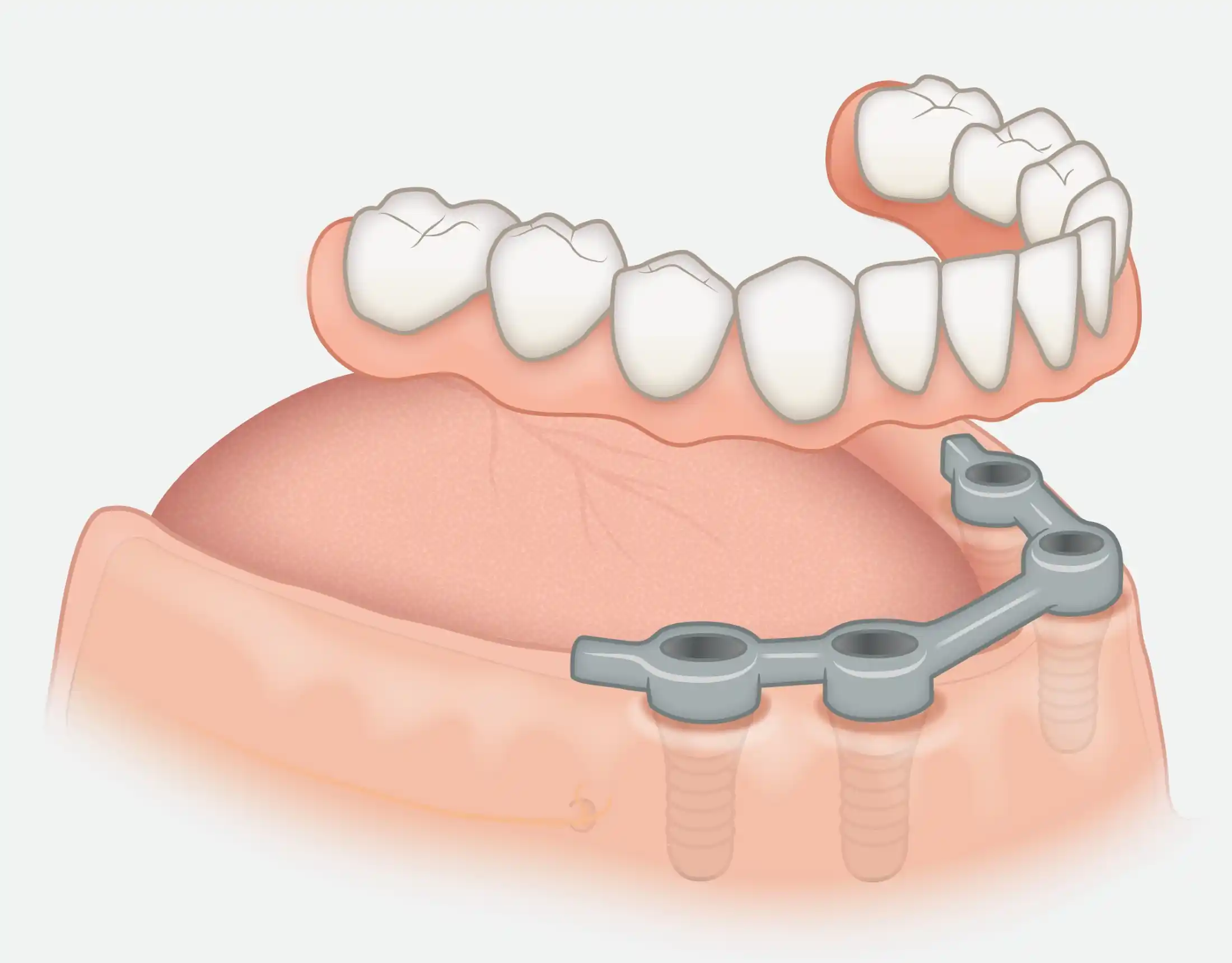
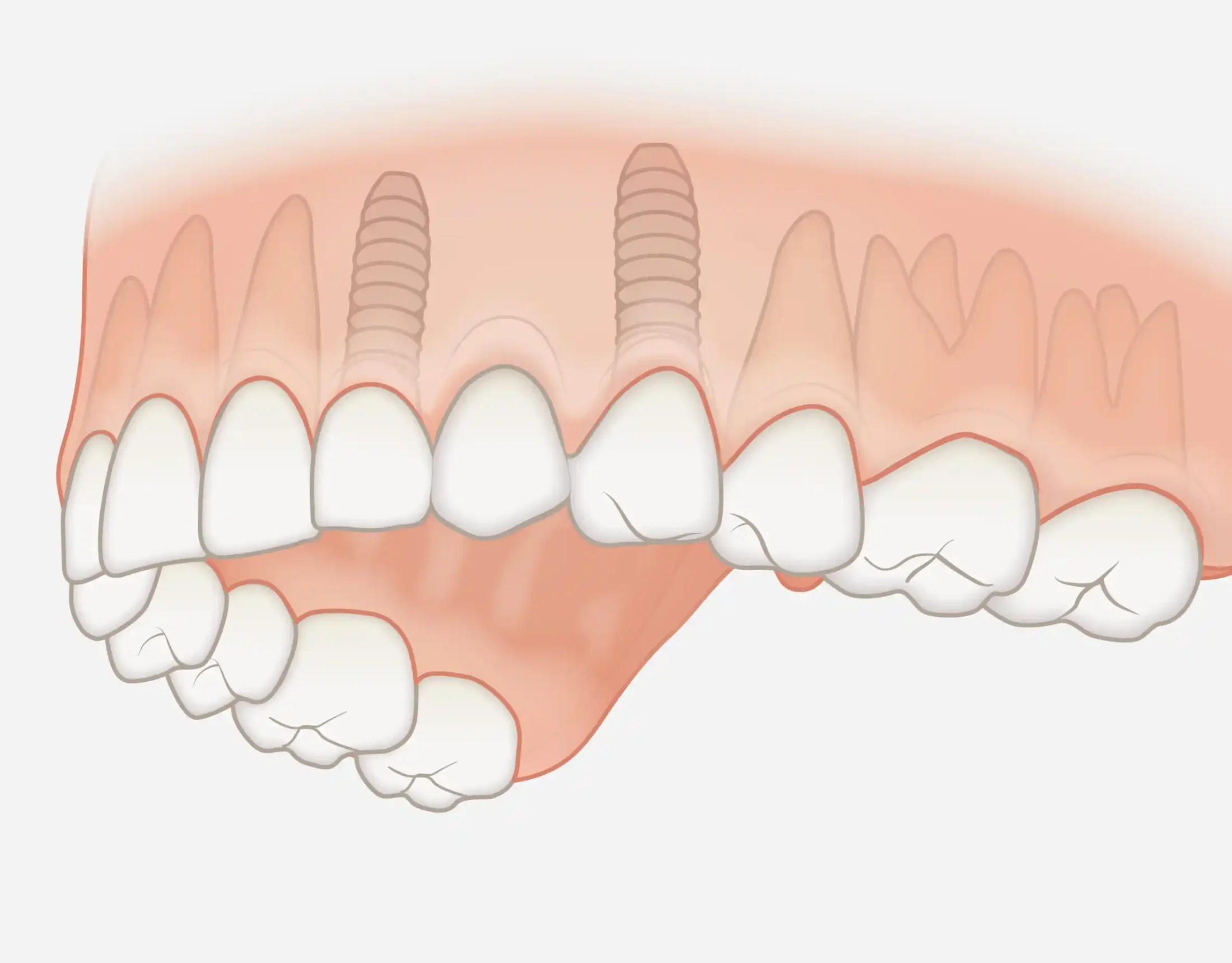
If all teeth are missing in the upper or lower jaw, an implant-supported restoration is a particularly stable and comfortable solution. Compared with conventional full dentures, this option offers significantly more retention, security and quality of life. Depending on the individual situation, the restoration can be designed either as a removable denture or as a fixed bridge.
A removable denture on implants is used primarily when the jawbone has already receded significantly and bone augmentation is not possible or not desired. In such cases, at least two implants are usually placed in the lower jaw and typically four in the upper jaw. Special connecting elements are attached to these implants, such as press-stud attachments, ball anchors or a metal bar. The denture is secured to them and can audibly click into place when inserted. This ensures it sits securely in the mouth when chewing, speaking and laughing and does not slip. At the same time, it can be easily removed for cleaning.
If a fixed restoration is preferred, that is also possible. In this case, a bridge construction that remains permanently in the mouth is anchored on the implants. Depending on the jaw situation and available bone, four to eight implants per jaw are usually required. These implants serve as a stable base for a continuous bridge that is either screw-retained or cemented. In this case, the restoration feels particularly natural and can be used for speaking, chewing and smiling like real teeth.
Which of the two variants—removable or fixed—is the better choice depends on several factors. These include, among other things, the condition of the bone, personal preferences and medical requirements.
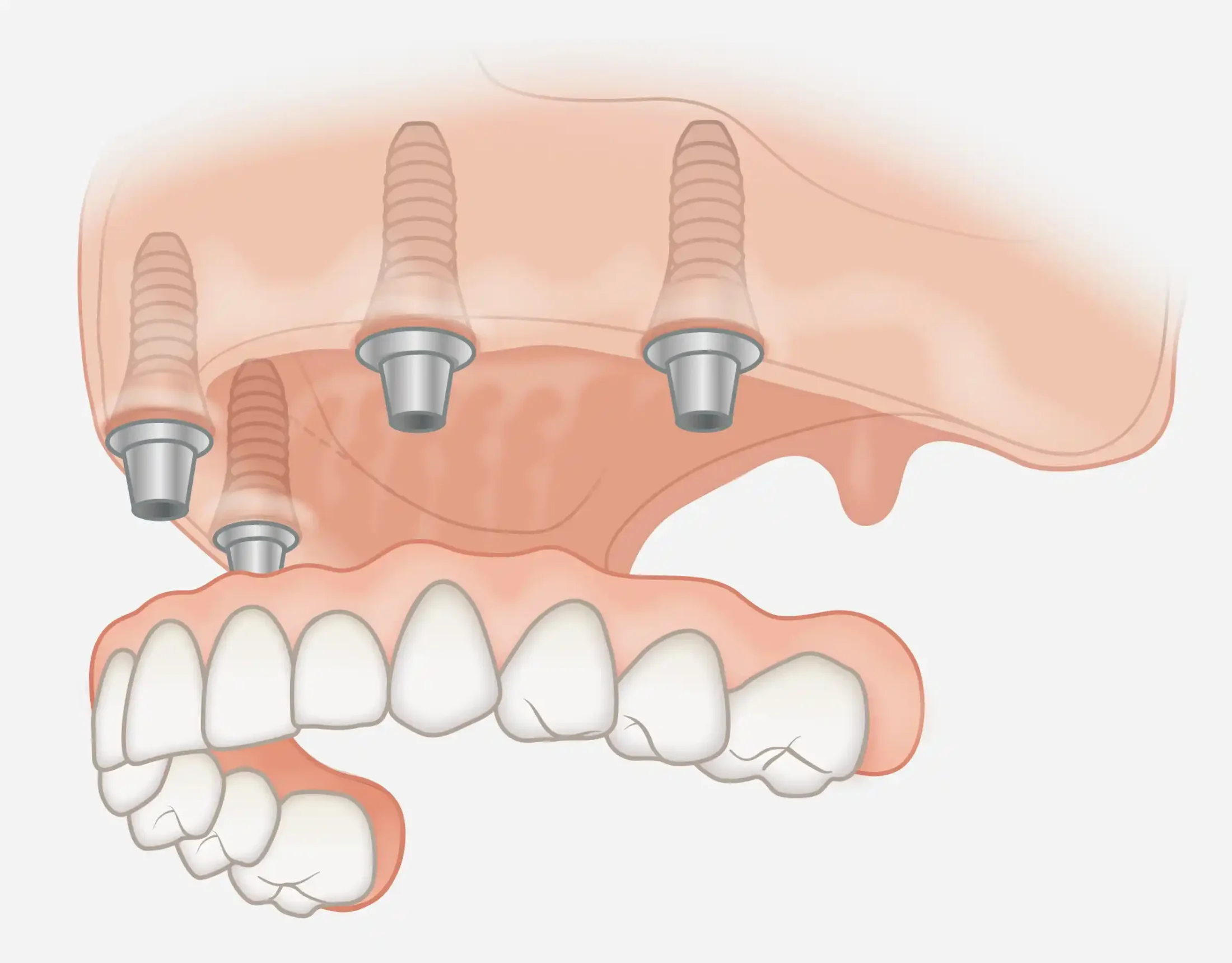
Which type of implant is right for me?
Which implant solution is best for you depends on several individual factors. A key role is played by the number and position of the missing teeth—whether it is a single gap or several teeth that need to be replaced. The condition of the jawbone is just as important: depending on how much bone is still present, different types of implants may be suitable, or bone augmentation may be necessary.
Your personal preferences are also taken into account—for example, whether you would like a fixed restoration or prefer a removable option. In addition, your general health is important, as is your oral hygiene, because both influence healing and the long-term stability of the implants.
Last but not least, your available budget and the timeframe in which the treatment is to take place should also be considered. A careful assessment by a qualified dentist in Switzerland is the best basis for finding the right implant solution—safe, individual and sustainable in the long term.
Materials: titanium or ceramic?
The material of an implant must be well tolerated by the body and remain permanently stable in the bone. In practice, two materials in particular have become established: titanium and ceramic (usually zirconium dioxide).
- Titanium implants: Since the 1980s, most dental implants have been made of titanium. Titanium is an extremely biocompatible metal, meaning it normally does not trigger allergies and is not rejected by the body. It is also very robust, resilient and reliably fuses with bone tissue. For these reasons, titanium is considered the gold standard for implants. The disadvantage of titanium is purely aesthetic: with very thin gums or in the front tooth area, the greyish colour of the metal can slightly show through at the gum line. In such cases, or for patients who wish to avoid metal in the body, ceramic implants come into play.
- Ceramic implants: These are implants made of zirconia ceramic. This material is whitish and therefore tooth-coloured, which is aesthetically advantageous. Ceramic is also biocompatible: it is well tolerated by the gums and bone, and fewer bacteria adhere to it than to metal surfaces. For people with allergies or patients with titanium intolerance, ceramic is an excellent alternative. However, ceramic implants are more expensive to manufacture and process. In the past, they were also considered somewhat more prone to fracture, but modern ceramics have improved. Nevertheless, ceramic implants still account for only a small proportion of all implants placed. Titanium continues to dominate due to its longer track record of success and lower costs.
- Other materials: In addition to titanium and zirconia ceramic, there are a few niche products made of high-performance plastics (e.g. PEEK), but these play hardly any role in routine practice. In Switzerland, most dentists rely on proven titanium implant systems from reputable manufacturers (some of which, such as Straumann or Thommen Medical, are Swiss companies).
Dental implants compared with other types of dental restorations
Dental implants are a modern, proven solution for replacing missing teeth, but they are not the only option. Many patients face the question: what is better—an implant, a bridge or a denture? The answer depends on the individual dental situation, personal expectations and also the budget.
Dental implant or dental bridge
A fixed dental bridge is often used when a single tooth is missing and the neighbouring teeth are still present. The two adjacent teeth are ground down and crowned in order to attach an artificial crown between them as the bridge pontic.
This can close a gap quickly and reliably, but grinding down healthy teeth is a significant intervention in the natural tooth structure. In addition, a bridge transfers chewing forces via the neighbouring teeth, which can lead to overloading in the long term.
An implant, on the other hand, replaces only the missing tooth without affecting the neighbouring teeth. It is anchored directly in the jawbone and acts like a natural tooth root. This also loads the bone in the region and preserves it in the long term. In terms of longevity, stability and protecting neighbouring teeth, an implant is generally the better solution, provided there are no medical limitations.
Dental implant or partial/full denture
Removable dentures, whether partial or full, are used when several or all teeth are missing. They rest on the gums or are anchored to remaining teeth. Although they are less expensive than implants, they also come with limitations: an unstable fit, pressure sores, reduced chewing function and aesthetic compromises are common complaints.
Implants offer clear advantages here: even in complete toothlessness, they can serve as a stable base for a fixed bridge or a removable but firmly anchored denture. Wearing comfort, confidence when speaking and chewing, and the feeling of having “your own teeth” are significantly higher than with conventional dentures.
Although dental implants involve greater effort and higher costs, they offer a particularly durable, comfortable and aesthetic solution. They replace teeth almost perfectly in function and appearance—and do so permanently. For many patients, they are now the first choice when it comes to quality of life and oral health.
Frequently asked questions about dental implants

Do you have questions or would you like a consultation?
Are you still unsure about dental implant treatment? Do you have suggestions or requests for us? We look forward to hearing from you!

